 Dog Thunder
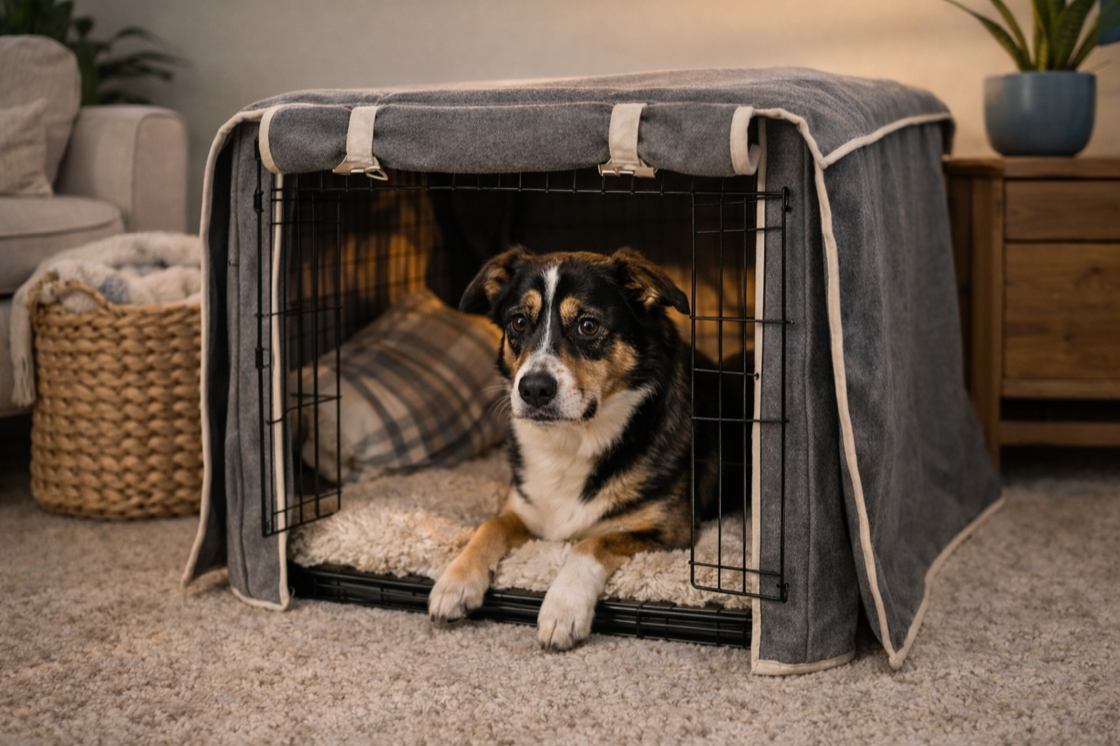
Key takeaway: From standard wire crates with covers to specialty anxiety dens like ZenCrate and Impact's High Anxiety Crate, build a safe space your dog actually wants to use during storms.
Confused by all the 'thunder' products?
Why dens work
Dogs are descended from animals that used dens for safety. This instinct persists: when scared, dogs often crawl under beds, hide in closets, or squeeze into tight spaces. They're not being weird, they're following millions of years of programming that says "small, enclosed space = safe."
A crate mimics this den environment. When set up correctly, it becomes a retreat your dog wants to use, not a prison they're forced into.
Off Leash K9 Training notes: "Dogs who are properly crate-trained tend to have lower levels of anxiety and exhibit fewer behavioral problems."
The key phrase: properly crate-trained. A crate only helps if your dog has positive associations with it.
Crate training for anxiety (the short version)
If your dog wasn't crate trained as a puppy, it's not too late, but you need to build positive associations before expecting the crate to help during storms.
The basics:
1. Make the crate comfortable (soft bedding, familiar blankets)
2. Feed meals in or near the crate
3. Give high-value treats and Kongs inside
4. Never use the crate as punishment
5. Let your dog enter and exit freely at first
6. Gradually increase time spent inside with door closed
The timeline: Most dogs can be crate-trained in 2-3 weeks with consistency. Anxious dogs may take longer, patience matters.
Critical point: The crate should be available during storms, but ideally your dog should already love it before storm season. Introducing a crate during a panic attack creates negative associations.
Crate covers: creating darkness
Covering a crate with a breathable fabric cover creates a darker, more enclosed environment that feels safer to many dogs. It also:
- Blocks visual stimuli (lightning flashes, movement)
- Slightly muffles sound
- Signals "rest time" as part of a routine
Orvis notes: "A crate cover can be beneficial to many dogs and can help reduce anxiety and soothe dogs by limiting visual stimuli."
Important caveats:
- Not every dog likes being covered, some feel trapped
- Always leave ventilation gaps (never fully seal the crate)
- Use breathable fabric to prevent overheating
- Secure the cover so your dog can't pull it in and chew it
Start with partial covering and observe your dog's reaction. If they seem more relaxed, great. If they seem more stressed, leave it uncovered.
If you need one: we like the Explore Land Crate Cover for its universal fit.
What makes a good safe space
Whether you use a crate or create another designated area, the elements are similar:
Enclosed feeling: Three walls or more. A crate, closet, bathroom, or corner with furniture on multiple sides.
Darkness: Covered crate, room with blackout curtains, or interior room without windows. This blocks lightning and reduces visual stimulation.
Familiar scent: Your dog's bedding, a worn t-shirt of yours, or a soft calming bed. Scent is comforting.
Sound dampening: Interior rooms have less noise. Add white noise or calming music. Some owners use acoustic panels or heavy curtains.
Access to you (optionally): Some dogs want to be near their person; others prefer to hide alone. Let your dog choose.
Setting up a storm-specific safe space
Here's a practical approach for creating a storm retreat:
Choose the location:
- Interior room (bathroom, closet, basement) = less thunder noise
- Away from windows = no lightning flashes
- Easily accessible = dog can get there when needed
Add comfort layers:
- Crate with soft bedding (or dog bed in a corner)
- Crate cover or blankets draped over furniture
- Your worn clothing for scent comfort
- Water bowl
Add sound masking:
- White noise machine or fan
- Calming music (classical, reggae, or specifically designed dog music)
- TV at moderate volume
Make it available before storms:
- Check Dog Thunder alerts
- Open the safe space 30+ minutes before storm arrival
- Offer a frozen Kong or lick mat to build positive associations
If you need one: a white noise machine can help mask thunder in an interior room; use it before storms so it becomes part of the routine.
Specialty anxiety crates
For dogs with severe anxiety who've destroyed standard wire crates or injured themselves trying to escape, there are heavy-duty options. This happened to Juniper once; she was at a kennel and was in a wire crate and chewed her way out, losing a tooth. We didn't have medication for her at that point, but now we leave detailed instructions for any kennels we use, to give her medication if there's any risk of storms, or if one happens. Here are a few options for specialty crates:
Impact High Anxiety Crate (~$900-1,300)
Aircraft-grade aluminum construction with extra latches. Designed to be escape-proof and prevent self-injury. Small ventilation holes prevent dogs from getting teeth caught or paws trapped, which matters most for dogs who have already damaged wire crates or hurt themselves trying to escape. It is expensive and most dogs do not need it, but for severe storm anxiety where safety is the concern, it is the strongest option here.
ZenCrate (~$600-800)
Unique design with built-in features: motion-activated calming music, vibration dampening, reduced light. Designed specifically for storm and noise anxiety. More information at (ZenCrate).
Rock Creek Separation Anxiety Crate (~$600-1,000)
Welded aluminum frame, chew guards, escape-proof door. 5-star crash test rating. More information at (Rock Creek).
These are expensive, but for dogs who've injured themselves or destroyed multiple standard crates, they can be worth it for safety alone.
Most dogs don't need these. A standard wire crate with a cover works fine for mild to moderate anxiety. Heavy-duty options are for severe cases where safety is a concern.
Crates Worth Checking Out
Best Friends by Sheri Original Calming Donut Bed
Best Friends by Sheri
Sizes: 18" to 54"; faux fur; machine washable
Furhaven Snuggery Hooded Dog Bed
Furhaven
Hooded design; CertiPUR-US certified foam; sizes 18"-44"
MidWest Homes for Pets Dog Crate Cover
MidWest Homes for Pets
Machine washable; 1-year warranty
Midwest Homes for Pets Dog Crate
MidWest Homes for Pets
All-in-One Starter Kit: A convenient bundle with key essentials to help you welcome and care for your new large-sized dog
Easycom Dog Crate Furniture Foldable
EasyCom
Foldable, made from wood and looks more like furniture.
Alternatives to crates
Not every dog takes to crates, and that's okay. Other safe space options:
Closet corner: Clear out a space, add a dog bed and blankets. Naturally enclosed and dark.
Under furniture: Some dogs naturally hide under beds or desks. Make it comfortable with a bed and let them use it.
Bathroom: Interior room, tile floors (easy to clean if accidents happen), no windows in many bathrooms. Add bedding and close the door during storms. Juniper likes the bathroom during a storm.
Covered exercise pen: More space than a crate, but still enclosed. Drape blankets over the top.
The key is identifying where your dog already tries to go when scared, then making that space more comfortable.
What not to do
Don't force your dog into the crate during a storm. If they're already panicking, forcing them into an enclosed space can make it worse and create negative associations.
Don't lock them in if they're not crate-trained. An untrained dog in a locked crate during panic can injure themselves trying to escape.
Don't use the crate as punishment. Ever. The crate should always be associated with comfort, not discipline.
Don't expect the crate alone to solve severe anxiety. For dogs like Juniper, the safe space is one tool among many, medication, ThunderShirt, white noise, and advance warning all work together.
The bottom line
A properly set up safe space gives your dog agency during storms. Instead of panicking with nowhere to go, they have a familiar, comfortable retreat that feels secure.
For many dogs with mild to moderate storm anxiety, a covered crate in a quiet room with white noise is enough to help them cope. For severe cases, the safe space is still valuable, just as one component of a larger approach.
The goal: when your dog hears thunder, they know exactly where to go and feel safer when they get there.
Related: How to Help Your Dog During Storms Without Prescription covers the full toolkit of non-medication approaches.
Disclaimer: This guide is informational only and not a substitute for veterinary advice.